

How To Use The Tornado Brush Cleaning Gun
Python Tornado, A Quick-First Guide
What is Tornado?
Tornado is a Python web framework and asynchronous networking library. It'southward well-nigh poular utilize is probably for web applications that require scalability, just it can exist used for many other applications.
The key features of the library are supposed to be:
- the power to handle thousands of connections per 2d
- native support for WebSockets
- simple API
- off-the-shelf components.
It is designed to exist scalable, simple, and lightweight. Similar all Python frameworks, Tornado is 100% event driven. Its in-memory cache and use of non-blocking sockets makes it ideal for applications that spend most of their time waiting on network requests or generating output.
You tin can easily Deploy a Python Spider web App online
Why use Tornado?
I use tornado a lot. And sometimes I become questions and people who asks me: "Why tornado? why Python? Why not Get?". Well, the questions are easy to answer, I will effort to answer them here.
There are two main reasons to utilise tornado for your next spider web application:
Tornado doesn't get in your way
Tornado provides a fix of libraries that brand it easy to do the hard parts of edifice a web application. Since tornado provides merely the libraries yous need, your lawmaking remains clean. You don't have to fight with a big framework equally y'all would with other spider web development frameworks.
Ease to scale
By using non-blocking network I/O, Tornado can scale to tens of thousands of open connections, making it ideal for long polling, WebSockets, and other applications that require a long-lived connection to each user.
Tornado is 1 of the most prominent libraries in Python for developers who build high-operation, low latency web applications.
If you are a Python developer and you haven't heard of Tornado, then yous are probably living nether a stone (don't worry, it's cool). And at that place are more reasons why y'all should consider using Tornado instead of other frameworks, particularly if your application has high demands on operation and scalability.
Tornado Instance
Hello Globe
In python, it is very mutual to use the unproblematic "hello world" example to learn how to lawmaking and create a programme.
Below is an example of the simplest of spider web applications, hullo globe written in Python and using the Tornado web server.
Although the higher up code may look complicated at first, it actually is very elementary. It makes use of the tornado module and tornado templates to create a program that when called will output a simple "hello world" message.
import tornado.ioloop import tornado.web class MainHandler ( tornado . web . RequestHandler ): def get ( self ): self . write ( "Hello, globe" ) def make_app (): return tornado . web . Awarding ([ ( r"/" , MainHandler ), ]) if __name__ == "__main__" : app = make_app () app . listen ( 8888 ) tornado . ioloop . IOLoop . current () . start () It starts a spider web server at port 8888. This is accessible at your web browser using the url http://localhost:8888
if __name__ == "__main__" : app = make_app () app . mind ( 8888 ) tornado . ioloop . IOLoop . electric current () . showtime () The application is divers in the office make_app. This contains all URL routes. When yous type a URL into your browser, the server then knows what web page to return to y'all. In Python, this web server is called the web framework. In this instance it returns the go() function in the MainHandler grade for the / route.
def make_app (): return tornado . web . Awarding ([ ( r"/" , MainHandler ), ]) The function beneath is called whenever the / route is opened. It returns the text "Hello, world" to the browser or any you change it into.
class MainHandler ( tornado . web . RequestHandler ): def become ( self ): self . write ( "Hi, world" ) 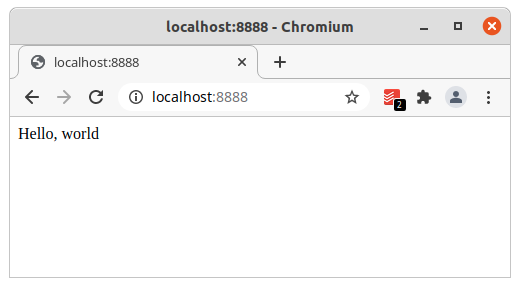
API with Tornado
The API, or Application Programming Interface is how you communicate with an awarding or programme. It's a technical way to get data from another source directly in your app. The basics of APIs is how to make requests and get responses from other servers. An API is like a betoken of connection between two things.
The program below is a simple HTTP API with 1 terminate point called /. Whenever you open that endpoint, it returns a message in JSON format.
JSON is a text format that is completely linguistic communication independent but uses conventions that are familiar to programmers of the C-family of languages, including C, C++, C#, Java, JavaScript, Perl, Python, and many others. These properties make JSON an platonic data-interchange language.
The JSON Data in this example:
{ 'message' : 'hello world' } The complete example:
# Load tornado module from tornado.web import Application , RequestHandler from tornado.ioloop import IOLoop # URL request handler class HelloHandler ( RequestHandler ): def become ( self ): self . write ({ 'message' : 'how-do-you-do world' }) # define terminate points def make_app (): urls = [( "/" , HelloHandler )] render Application ( urls ) # Outset server if __name__ == '__main__' : app = make_app () app . listen ( 3000 ) IOLoop . instance () . showtime () Run it in the last with the command:
It starts a web server on your computer on port 3000. The function app.listen() defines the port.
Open your web browser and type the url http://localhost:3000/ which has the end bespeak /. It should output the json data.
Why Python for spider web evolution?
Why Python for web evolution?
Yous can easily deploy your web app online with Python
Why Python?
- Python is easy to learn
- It has a simple syntax
- There are many courses and tutorials available
- The community is big and helpful
- Information technology is free
Python is a general-purpose programming linguistic communication, only information technology's often referred to as a "scripting language." Students coming from a Java, C++, or C# groundwork are particularly skeptical. They've been taught to build large-scale industrial software. They're used to writing code that has to run on hundreds of diverse configurations and thus needs to be perfect.
Python code, nevertheless, tends to be less mistake-prone because it is very short and simple (in fact, it's oftentimes said that the average line of Python code has just 5 words ). This ways that coding in Python is but easier than in other languages.
Only what about spider web evolution? Isn't that different? Shouldn't I exist writing object-oriented code?
No! For web development you should write mostly pocket-size chunks of procedural code, not object-oriented ones.
What is a Spider web Framework?
A web framework is a prepare of tools that helps you develop spider web applications more quickly. They ease the developer's burden by providing a set of libraries that handle mutual tasks like data persistence, hallmark, etc.
The Python Web Framework landscape is quite varied and in that location are many different tools available to developers today.
Web development frameworks provide a standard set of tools for rapidly creating spider web apps, including everything from database support to user hallmark.
In this way, a framework presents all the building blocks which permit y'all to create your own applications.
So here nosotros have: Tornado, Django, Flask, Pyramid, Bottle. These are the dissimilar frameworks available to you as well as their respective libraries.
The choice of framework is a crucial conclusion. It is as important as the option of platform (Cherry-red on Track, Python etc.) and the selection of database (postgresql, mysql etc.).
The framework will have a profound impact on productivity and on the ease of development. It volition also make a deviation to operation. So, it is important to have some fourth dimension to understand the different Python frameworks in detail.
These frameworks are all skilful tools, merely there is no one-size fits all. The best Python framework for your projection depends on the requirements and your team'southward development experience.
Python Tornado vs Flask
Tornado is a python spider web framework and Flask is a python micro framework. Tornado is very well established while Flask, on the other manus, is pretty new. Both frameworks are designed for different uses. However, when it comes to the performance of these frameworks, many people wonder which one actually stands out.
Flask is designed to build rapid development web applications. It relies on the Werkzeug WSGI toolkit which provides a simple and fast Python spider web application, which uses its ain internal HTTP server for serving the application.
from flask import Flask app = Flask ( __name__ ) @ app . road ( "/" ) def hello (): render "Hello World!" if __name__ == "__main__" : app . run () Tornado is designed to build scalable real-time spider web applications. It relies on asynchronous programming, non-blocking sockets and a pretty fast HTTP server. It's easy to write, runs on Windows and Linux, and has all the features you need for mod traffic handling, including fast HTTP 2 support.
Tornado vs Django
Beginning off, I love both frameworks. They're both fantastic, and either 1 would exist great for a lot of applications. If you're looking to go started with something new, I highly recommend either of them.
Tornado is a Python spider web framework and asynchronous networking library, originally adult at FriendFeed. By using non-blocking network I/O, Tornado can scale to tens of thousands of open connections, making it ideal for long polling, WebSockets, and other applications that require a long-lived connexion to each user. It'due south written in Python and uses a few C libraries.
While Tornado ships with its own version of a web server, information technology is as well able to act as a WSGI server (using the wsgiref.simple_server). This ways that any WSGI-compliant application can act equally a web server for Tornado. For example, you could use mod_wsgi to serve Tornado applications from Apache.
For those who haven't seen it already, Tornado is an asynchronous networking Python framework based on the upshot loop / libevent model. It is designed for scalability and concurrency.

Django is a popular spider web framework written in Python. It is ambitious, and most of its goals (peculiarly simplicity) are accomplished very well. Information technology'south straightforward to get started with it, and yous don't have to remember about much but your problem domain right from the starting time.
Undoubtly, one of the reasons why Django gets so much love - amidst programmers - is that it eliminates all of the boilerplate code that'due south associated with frameworks such as Rails. It'southward all there, pre-fabricated, and all you have to practise is to take it and run with it.
Tornado vs Node.js
As a backend developer, you have probably heard of Node.js. It has been gaining popularity lately and its use is spreading like wild fire, peculiarly for web applications. It is advertised every bit a very fast server side engineering science that uses less memory and handles high concurrency well. Unfortunately, information technology does not always perform besides as advertised.
This is mostly due to the fact that Node.js was built with JavaScript in mind. Node.js is non suited for Python, a linguistic communication that has its roots in C and which is ofttimes used for scientific computations (numpy). Tornado, Python web framework, outperforms Node.js when it comes to handling existent fourth dimension applications.
Tornado'southward biggest feature is its non-blocking, asynchronous IO. This was a revelation when it was first introduced, and it has since been copied past pretty much every major web framework. Merely why is asynchronous IO so of import?
The surreptitious to a scalable server is to keep the issue loop total. If your event loop tin't keep upwards with the incoming requests, and so y'all have several problems:
Y'all tin't serve any async requests at all. You must respond in series, which means that y'all will probably drop some of the incoming requests. (This is "starvation").
Losing 1 request may non sound similar a big deal, but think that each request takes some piece of work to process - bytes to read from the socket, network round-trips to the database, etc. If you're dealing with many thousands of requests per second, dropping each one makes a huge difference!
There is ane class of input where asynchronous processing really pays off: real-time information.
Chop-chop, signal-by-point:
-
Node.js is a runtime, however Tornado is a web framework. Although it's possible (and often done) to use Node.js to write servers, you'd exist amend served past using an bodily spider web framework.
-
Node.js is single-threaded, Tornado is multi-threaded.
-
Node.js can just barely support async programming, only it'south kind of an afterthought and the API is somewhat awkward. In Tornado/Python real back up for asynchronous programming is built in.
-
Node.js has a ton of modules, many written in JavaScript. Tornado/Python has far fewer modules, merely they're all written in Python which is arguably easier to read than JavaScript.
While Node.js does provide non-blocking I/O, it lacks an HTTP server framework. If you're only developing with Node, you'll accept to rely on third-party modules or build your own framework from scratch. In contrast, Python comes with Tornado which is an in-house framework developed by the Python customs for developing robust and scalable production web servers.
With a focus on ease of utilize and simplicity, Tornado makes it easy to go started and learn. As the simplicity of the linguistic communication makes it an fantabulous teaching tool, information technology also has a small-scale learning bend which allows for quick prototyping.
Web Application Basics
What is a spider web browser?
A web browser is a programme for accessing information on the Globe Broad Web. You can call up of a web browser as a window into the Net. When yous point your browser to http://www.python.org you see the content on our website. Without a browser, such as WebKit, and without a connection to the internet, you wouldn't exist able to meet our site.
The most popular web browsers today are Chrome, Firefox, Safari and Net Explorer/Edge, but some other browsers are available, such as Opera.
It is hard to believe now, but when the Spider web was first conceived and developed in 1989 by Tim Berners Lee, in that location was no way for people to open a browser and just "surf" to whatever website they wanted to encounter.
What is a server?
A web server is a computer that serves your website to the guests. Each website lives on a special folder on your computer and every time someone requests this folder (for example http://world wide web.website.com) - the server sends the contents of this binder back to that guest using Apache (or Nginx) web server software.
Well-nigh every website in beingness runs on a web server, sometimes more than one. Some websites have a single web server that serves the whole site, some web services like blogs might take ane web server per user business relationship.
With Python you tin can build your own server (comes by default with many web frameworks) and serve your web application. Information technology is commonly referred to every bit back-end.
What is an API?
An API is a programmatic interface that allows a plan to talk to other programs. APIs tin can be used by developers to brand programs that share data or functionality. This is how apps similar Twitter, Facebook and Gmail tin share information with each other.
A pop way to call up of an API is the "back door" of a website. Websites ofttimes accept "dorsum doors" so they can share information with programs.
While APIs take existed for decades, they've merely recently go a core part of the web, powering everything from your Twitter feed and Gmail inbox to your Facebook newsfeed and route to the Instagram photos of your favorite singers. Past creating an API, developers are able to provide a programmatic interface to resources of various kinds.
What is web sockets?
Spider web sockets permit 2-way real time communication between the browser and a server. With this, pages tin can update their content instantly from the server without refreshing the page. It's like polling, but more efficient.
Web sockets give your web browser and the web server an ongoing ii-mode connection, rather than the usual unmarried asking/response interaction. This is useful when yous want to ship continuous updates from the server to the client as it happens, without having to send a bunch of individual letters or keep the connection open up continuously. You
Web sockets is an emerging web technology that allows real-fourth dimension bidirectional communication between a browser and a server.
What is WSGI?
WSGI is a Python standard for web servers to talk to web applications.
A Web Server Gateway Interface (WSGI) is a standard interface between the web server and the Python web application framework. WSGI allows Python developers to design and implement web applications independent of the deployment environs.
What is HTTP?
HTTP is a protocol for transferring data betwixt a spider web browser and a server. The protocol is designed for quick admission to the resource on the web, such every bit text, graphics, sound, and video.
A HTTP stands for HyperText Transfer Protocol. HTTP is the protocol that powers the web, and in particular, the www. It's an application layer protocol designed to transfer files from one estimator to another across networks and the internet.
In a nutshell, here's how it works: when you request something from a server, the server sends you back a response. This response contains 3 things:
· The requested resource (the file) · The HTTP status code (due east.m. 200 OK) · Any other metadata or headers that the server might need to convey
Each time you type an URL, you asking something from a server.

Source: https://www.python-me.org/tornado
Posted by: jacksoninswer.blogspot.com
0 Response to "How To Use The Tornado Brush Cleaning Gun"
Post a Comment