

How To Install Icc Profile Windows 10
Author: Adam Simmons
Terminal updated: September 30th 2021
Introducing ICC
Ideally a user will plow a monitor on and experience the image is really simply what they were after on any awarding they run – no tweaking necessary. Realistically, though, the user will most likely fiddle with a few things on the monitor OSD (On Screen Brandish) to attain the paradigm they're looking for. Sometimes lowering the brightness a bit, having a footling play with the RGB settings (colour channels) and maybe switching gamma modes can make a world of difference. In our reviews we try to requite users some suggestions for settings they can employ on a monitor to give a rich and well-counterbalanced epitome. There is e'er some degree of variation between individual units of the aforementioned model but this tin can often provide a useful starting point.
Occasionally we come beyond models which merely don't give a pleasing paradigm no matter how much tweaking yous practise on the OSD. One way to overcome these limitations is to apply International Colour Consortium (ICC) profiles. The most complete and authentic creation of such profiles (a procedure aptly named 'profiling') is done past a hardware calibration device such every bit a colorimeter. ICC profiles essentially modify the graphics card's Wait Up Tabular array (LUT) and gamma table so that the monitor displays different and ideally more than correct colours than what it would natively. A relatively slender choice of monitors too allow the LUT and gamma curves of the monitor itself to exist directly calibrated in a like mode. The upside of a proper calibration is a (sometimes vastly) improved image with more than accurately represented colours. The downside is a potential reduction in contrast and sometimes in shade variety.
Activating the profiles
Due to user feedback we now provide downloadable ICC profiles for monitors we review. Just we just recommend using them and perform our testing using them if the model tin't be gear up appropriately using OSD (On Screen Brandish) adjustments alone. In gild to use these profiles they must be activated as detailed below – alternatively you can use the 'Display Profile' utility mentioned towards the end of this article. These instructions apply to Windows Vista, seven, 8, 8.1, 10, 11 and peradventure future Windows versions. Note that individual units vary and you can't expect optimal results simply by using somebody else's profile. It is always all-time to create such profiles yourself, on your own unit, where possible.
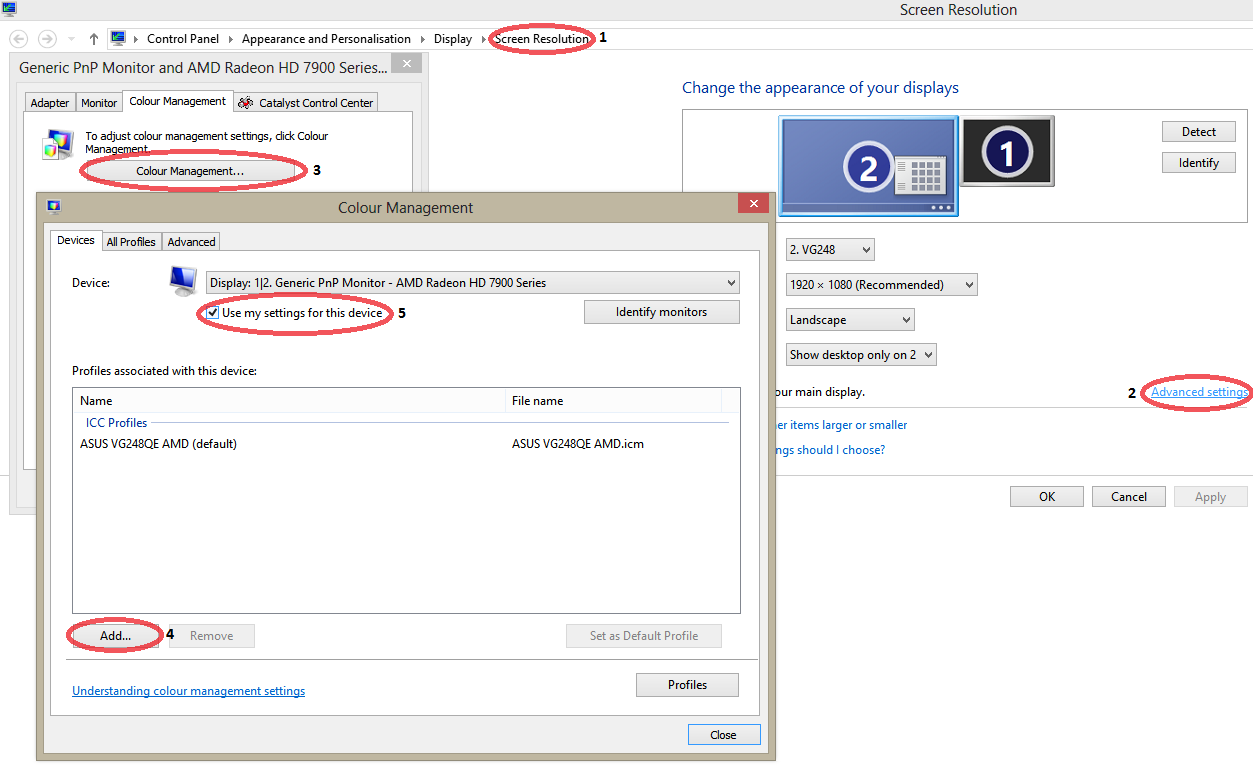
1) Navigate to 'Command Panel – Appearance and Personalisation – Brandish – Screen Resolution (or Adjust resolution)'. On Windows 10 and eleven it is easiest to simply type 'Colour Management' into the 'Search Bar' on the taskbar and skip to footstep iv.
2) Click 'Advanced Settings'.
3) Click on the 'Colour Management' tab and printing the button labelled 'Colour Direction…'
4) Ensure the 'Use my settings for this device' checkbox is checked.
five) Printing the 'Add' button and then 'Browse…' to the ICC profile you merely downloaded. Press 'Add' and so 'OK'. Notation that if multiple ICC profiles are listed you will have to set the desired profile as default by clicking 'Set up as Default Profile', too.
It is also necessary to enable the gamma correction elements of the ICC profile. This is done by irresolute 'System Defaults' every bit follows. Note that the image is only an example. Your dropdowns may differ from what is shown here, but it'due south important to tick the checkbox every bit covered in steps 6 and 7.
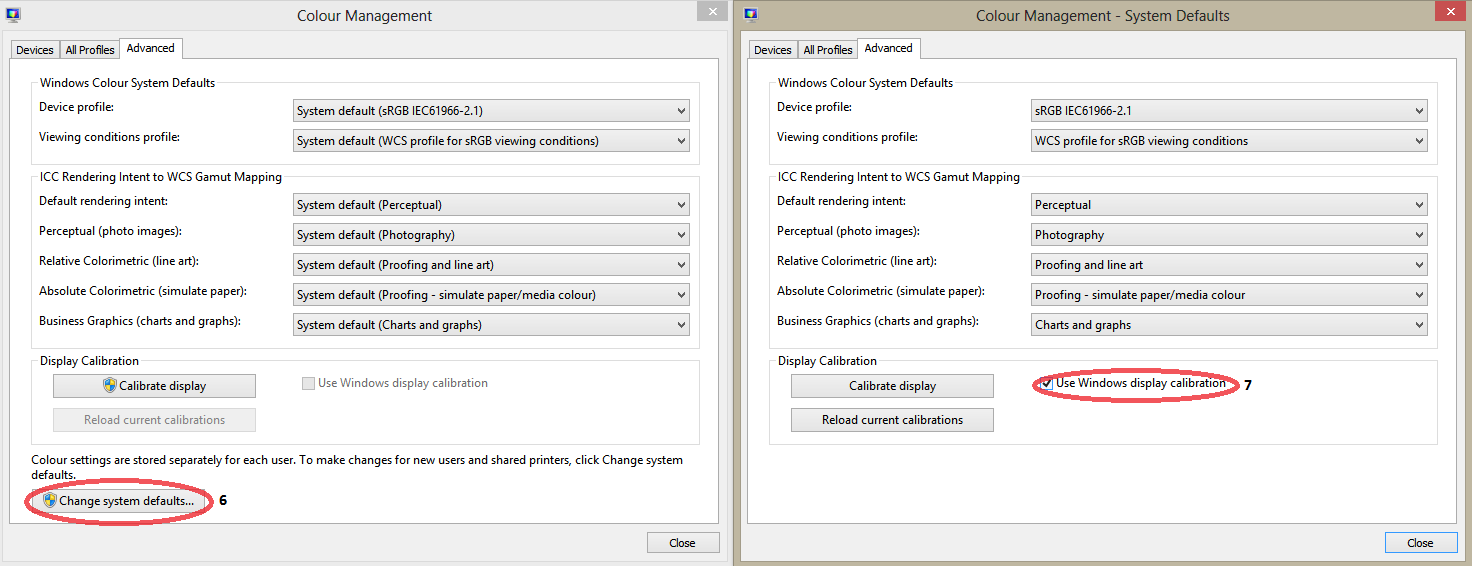
6) Click on the 'Avant-garde' tab in Color Management and printing 'Modify system defaults…"
7) Navigate again to the 'Advanced' tab, this time in the 'Colour Management – System Defaults' window. Ensure the 'Apply Windows display scale' checkbox is ticked.
You can now close the Colour Management windows. All elements of the ICC profile should now be loaded and used correctly by the arrangement on the desktop.
Not color-enlightened applications
At that place are certain applications which have their own agenda. Games are an case of applications which are not 'colour-aware', meaning some of the data contained with the ICC profile is ignored. Importantly, no colour gamut transformations are performed. Such applications may too be referred to as not 'ICC aware' or but 'non-colour managed'. Under SDR (Standard Dynamic Range), the sRGB colour space is targeted. And regardless of whether an ICC profile is used, if the monitor has a wider gamut than sRGB it will oversaturate colours. The Windows desktop is not color-aware, either. And whilst color direction is increasingly supported by modernistic spider web browsers, it doesn't necessarily utilise to all elements on the web page. Video content with hardware dispatch enabled, for example, typically ignores much of the ICC profile data. This is where sRGB emulation comes into its own, restricting the color gamut appropriately for sRGB content. Under HDR the wider DCI-P3 colour space is the near-term target and Rec. 2020 the longer term goal, with adept coverage of these colour spaces from the monitor being desirable for accurate output.
Games misbehaving
Some games, such as sure Steam titles, will choose to completely ignore desktop color data including any applied ICC profile. It might be tempting to 'enforce' the contour on games that don't use the desktop settings. This can exist done using a utility such every bit a DLL injector (ColourClutch), another enforcement utility or running in 'borderless window' mode. When enforcing a profile in this way y'all often cease up with the games incorrectly transforming (or partially transforming) colour and gamma information. Games that disregard the desktop settings use a range of different baselines for colour and gamma information which differs from that of the Windows desktop environment. So even if the ICC profile is 'enforced' it won't be doing what it should, basing its corrections off the desktop rather than game baseline. Such games are designed to work with the GPU's default LUT and gamma configuration but and once you change this 'logic' all sorts of bug can occur. You can get some small banding issues even if ICC contour are used 'properly', only that doesn't compare to the more noticeable bug that can occur if the profiles are enforced. Gamma issues, shade crushing, extensive banding, grey neutrality bug and incorrect colours are all quite mutual.
If you're using a monitor with a good colour setup from the OSD at that place is really no need to apply an ICC profile for any game, but that can't be said for all monitors unfortunately. In that location are enough of games out there that will use the desktop color settings every bit their baseline, significant that they will exist able to use at least some of the information contained in the ICC profiles. As noted earlier, this would exclude color gamut transformations. Simply on monitors where the prototype simply doesn't look at all appealing after OSD adjustments alone, things tin can certainly look better once an ICC profile is used. Just be enlightened of those titles that seem reluctant to use ICC profiles and don't be surprised if these games don't quite look correct if you enforce the profile.
DisplayProfile to easily switch between profiles
Obviously it would be a pain to have to go into Colour Direction and switch profiles on and off every time you lot wanted to play a certain game or return to the desktop, or switch between multiple profiles for dissimilar purposes. Windows 10 and 11 include a drop-downwards list in 'Display Settings' which makes this easier. Alternatively, there is an first-class and tiny utility called 'Display Profile' (to a higher place), created by 10-Rite, which gives you a very quick and convenient way of doing this. You can download it here. This allows you to toggle betwixt ICC profiles or use the system defaults if you essentially want to disable whatsoever ICC contour corrections. This utility lists profiles located in '10:\Windows\system32\spool\drivers\colour', where 'X' denotes the drive you've installed Windows to. You tin therefore but drag and drop any profiles to this folder and they should be selectable in this utility. To use arrangement defaults and disable any specific LUT and gamma corrections simply select 'sRGB IEC61966-two.1' in the utility.
As an Amazon Associate I earn from qualifying purchases made using the below link. Where possible, you'll exist redirected to your nearest shop. Further information on supporting our work.


How To Install Icc Profile Windows 10,
Source: https://pcmonitors.info/articles/using-icc-profiles-in-windows/
Posted by: jacksoninswer.blogspot.com
0 Response to "How To Install Icc Profile Windows 10"
Post a Comment